

Stroke Honing Impact on Bore Shapes
Honing Geometry Adjustments
- Taper: One end has a larger diameter than the other end. This is resolved by modifying the stroke length or dwell time.
- Out-of Round: Normally caused by expanding at too fast of a rate, abrasives that are cutting poorly or the way that the part is supported (tooling, fixtures). Expanding at too high a rate will deform thin wall parts causing them to go out of round or change size when the pressure is removed.
- Straightness: Bowed or Axial straightness is related to the axis of the bore. Once this condition exists, the tooling will normally follow. Longer stones are used to help straighten.
- Cylindricity: A value which includes roundness, straightness and taper in relation to a surface outside the bore. This is not normally affected by Honing.
Use Stone Travel to Adjust Geometry
.jpg)
.jpg)
How Stone Travel Affects Geometry
- Stones normally over-travel the ends of the bore by 1/3 of the stone length
- Blind bores cannot over-travel so Dwell, Short Stroking or Adjustable Tooling must be used to keep the bore straight
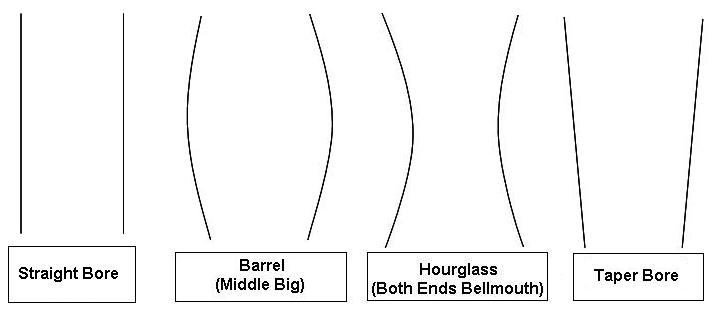
- Too much over-travel creates a Bellmouth Bore
- Too little over-travel creates a tight spot at the end.
- If stones are so long they do not clear the center of the bore, a barrel shaped bore will result
Bore Shapes
- These shapes result from various stroke adjustments
.jpg)
The Effect of Honing on a Bore
.jpg)